
Understanding Scoliosis
Learn what scoliosis is, the importance of awareness and how early detection supports better care.
What is scoliosis?
Scoliosis is a side-to-side (lateral) curve of the spine. This differs from the body’s natural front-to-back curve. Scoliosis is a spinal curve/s that measures greater than 10º. On an X-ray, the spine of a person with scoliosis looks more like an "S" or a "C". These curves may cause shoulders or hips to be uneven, depending on where your curves are located in your spine.
S-shaped curves can cause postural changes that may be more likely to be overlooked. Compared to a 'C' shaped curve, as you may notice, a person with a 'C' shaped curve favours one side or stands differently.
Idiopathic scoliosis is the most common kind of scoliosis. It accounts for 80% of scoliosis cases. "Idiopathic" means that the cause is not known. Though research indicates a likely genetic component, with 30% of adolescent patients having a family history of the condition.
Scoliosis awareness: mark your calendars
June is International Scoliosis Awareness Month
In 2008, the National Scoliosis Foundation launched Scoliosis Awareness Month to educate the public, reduce stigma, and advocate for change. Since then, June has become a time of action, visibility, and hope.
The global campaign encourages checking loved ones for physical signs—such as an uneven waist or rib prominence using early-detection methods. It aims to highlight the impact of spinal curvatures and promote public education.
Every June, we unite as a community to raise awareness, share stories, and advocate for early detection and treatment of scoliosis. Whether you’re a patient, parent, provider, or supporter, your voice helps us amplify this cause.
Spread awareness this June
- Request a proclamation in your area
- Talk to your school about introducing regular scoliosis screenings for students
- Wear green annually on June the 26th to show your support
Share your story
Whether you’re living with scoliosis or supporting someone who is, the National Scoliosis Foundation want to hear from you.
Share your experience using the hashtag #ScreenOutScoliosis and tag them @scoliosisfoundation.
Why scoliosis awareness matters
Scoliosis affects 1 in 40 children and up to 1 in 3 adults. An estimated 7 million people are affected in the U.S. alone. The onset of scoliosis generally occurs in adolescents between the ages of 10 and 18 years. It is an outdated misconception that 'scoliosis is only for girls'.
Most cases of scoliosis are mild and are non-progressive, don’t cause symptoms and don’t need treatment. Common in individuals who reach skeletal maturity and those whose curves simply never advance past the mild diagnostic threshold (typically 10° to 24°).
While it is a common condition, many cases remain undetected until they progress dramatically, particularly if changes aren't accompanied by pain. Moderate scoliosis is between 25 and 39 degrees; severe scoliosis is identified as more than 40 degrees.
Progressive 'S' shaped curves can create something known as a 'viscous cycle', meaning each curve will aim to compensate for the others' imbalances by progressing further. This happens during rapid times of growth among adolescents.
While predominantly thought of as a childhood condition, adult onset and progression of curves can happen; the prevalence in adults increases with age due to spinal degeneration. Symptoms can increase or appear as your body ages, which results in a late diagnosis.
How To: At Home Screnning
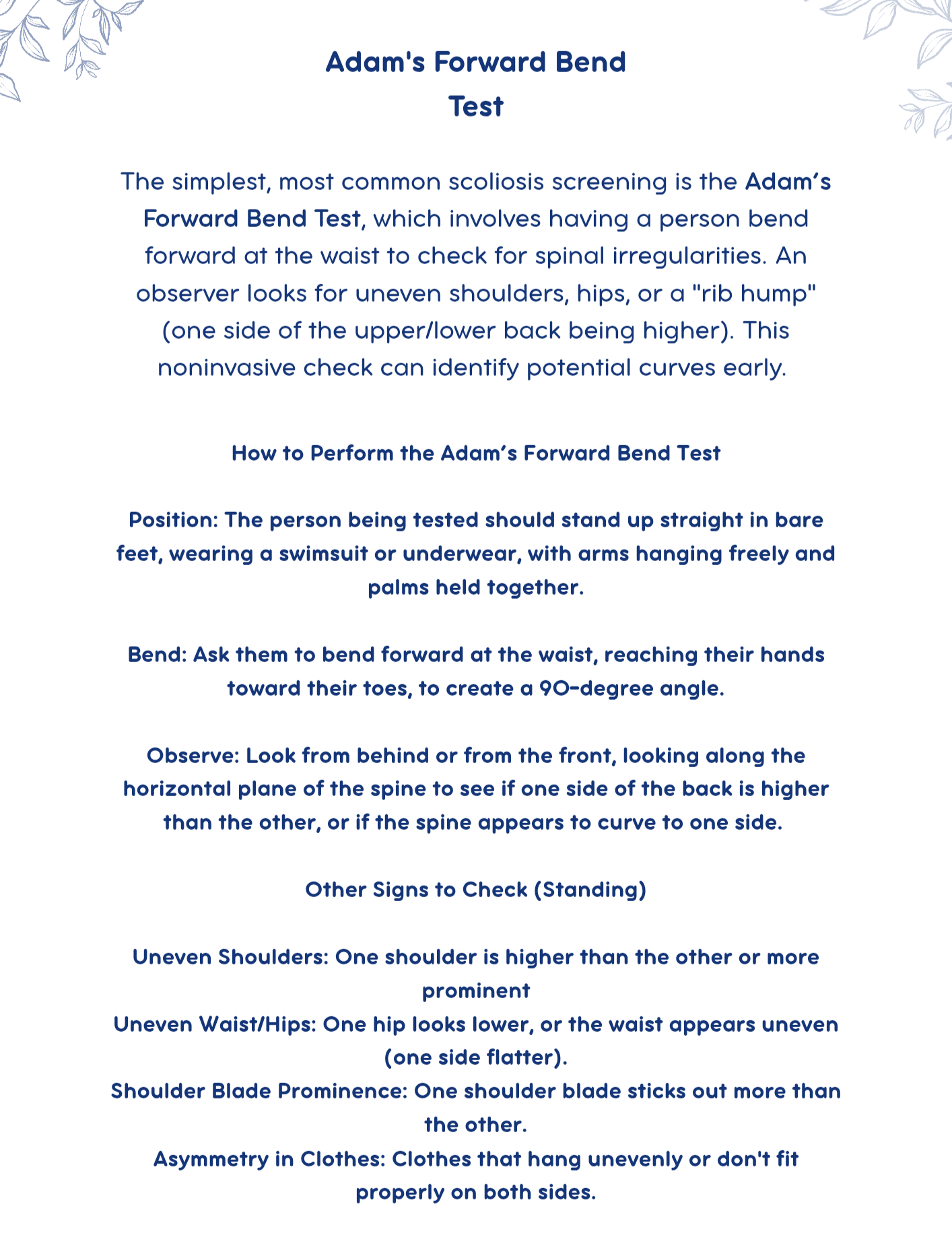
Several signs may indicate the possibility of scoliosis. The Adam’s Forward Bend Test is an effective way to screen at home. If one or more of the following signs are noticed, schedule an appointment with a doctor as soon as possible.
The current landscape of scoliosis treatment in New Zealand
Traditional treatments range from monitoring and bracing to highly invasive corrective surgery. Scoliosis surgery for young people in New Zealand is generally recommended for severe curves (typically over 45-50 degrees) that are progressing, with the primary goal of stopping the progression and correcting the deformity.
The most common surgery for adolescent idiopathic scoliosis (AIS) is posterior spinal fusion. This involves placing metal rods, hooks, and screws to straighten the spine and using bone grafts to fuse the vertebrae together.
Long-term problems from scoliosis corrective surgery often include permanent loss of spinal flexibility, chronic pain at the fusion site, degenerative changes in adjacent, non-fused vertebrae and overall decline in quality of living, particularly with ageing.
This is why education, early detection and proactive treatment are paramount for long-term wellbeing.
My commitment and your care
Please note: my services do not replace or substitute formal medical diagnosis or treatment. Because scoliosis can change quickly, it’s essential to stay connected with a trusted medical professional for timely care. As a fitness and exercise instructor, I am here to support you in a whole‑person way, complementing your medical team.
Resources
National Scoliosis Foundation US
Scoliosis Research Society
https://www.srs.org/Patients/Conditions/Scoliosis
Cleveland Clinic
https://my.clevelandclinic.org/health/diseases/15837-scoliosis